How to Get Sales Without Paid Marketing
How to Get Sales Without Paid Marketing
When I first started selling online in the UAE, most of my sales came from marketplaces and paid traffic. I was importing products from China, listing them, and paying to be seen. It worked — until it didn't. The moment I stopped paying, the sales stopped with it.
That was the lesson that shaped every business I built afterward. Paid marketing rents you attention. It never builds you an asset. The day the budget ends, you go back to zero. So the real question is not "can I get sales without paid ads?" — the answer to that is yes. The real question is whether you are willing to build something that keeps working long after you stop spending.
Key Takeaways
- Paid ads stop the moment you stop paying, but content and trust keep working for months and years.
- Customers search for specific problems, not "Home" or "About" — answer those questions and you get found.
- Own your customers through your own website and data instead of renting attention from ad platforms.
- A clear, well-structured site that Google and AI search engines can read is what earns steady, unpaid traffic.
Why paid ads stop working the moment you stop paying
Paid advertising is a tap you keep open. Turn it off and the water stops. That is fine when you need visitors quickly, but it is a dangerous place to live if it is your only channel.
I learned this the hard way. For years I depended on marketplaces and paid traffic, and I didn't truly own any of it — not the customers, not the relationship, not the future. When I finally built my own store and my own systems, sales started coming from work I had already done: pages I had published, products I had improved, customers who came back on their own. That is the difference between renting attention and owning an asset.
Answer the questions your customers are actually searching
Most small business websites have fewer than ten pages: Home, About, Contact, a couple of service pages, and that's it. The problem is that nobody searches for "Home Page."
Your customers search for specific things — "best office furniture in Dubai," "how to choose warehouse shelving," "garage software for a UAE workshop." If your website doesn't answer those exact questions, search engines and AI assistants have no reason to send anyone your way. Every real question you answer on your site is another door for a customer to walk through. This is why serious websites keep publishing blogs, FAQs, buying guides, and detailed product pages instead of treating the site as finished on launch day.
Teach before you sell
The businesses that win online almost always teach first. Instead of pages that only shout "buy our product," they explain how to choose the right one, compare the options, share what to avoid, and answer the worry a customer has before they buy.
When people find genuinely helpful information, they start to trust you. And trust is what turns a visitor into an enquiry, and an enquiry into a sale. Nobody buys from a business they don't trust, but people happily buy from a business that helped them understand their problem before asking for money.
Make your website easy for Google and AI to understand
Search has changed. People no longer only type into Google — they ask ChatGPT, Google AI Overviews, Gemini, Copilot, and Perplexity to recommend a product or a supplier. Those systems look for websites with clear structure, honest answers, and trustworthy content they can actually read.
This is the part most business owners dread, because it sounds technical. It shouldn't be your job. Eaglecart is built so the technical side is handled for you automatically — clean, fast, mobile-first pages, sitemaps, structured data, and internal linking are generated in the background, and it even publishes AI-discovery files so AI systems can find and understand your business. Your job is simply to write helpful content. The platform makes sure machines can read it.
Own your customers — don't rent them
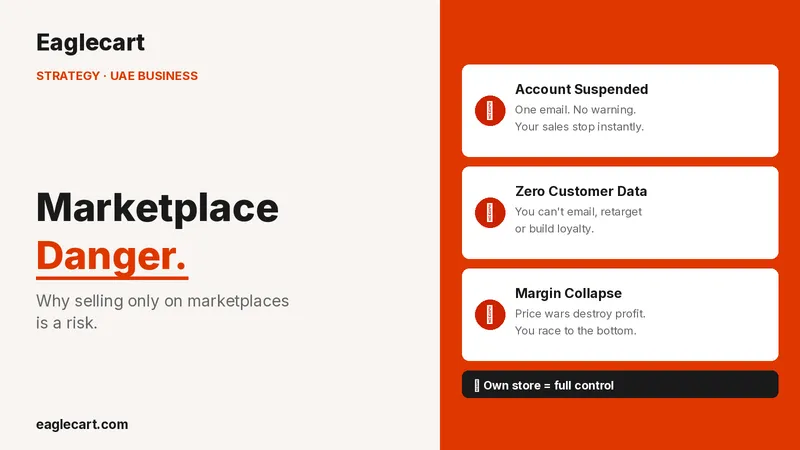
At our busiest we were processing around 1,700 orders a day, and one lesson stood above all the others: if you only sell through someone else's platform, you don't own your customers. You are building someone else's audience, not your own.
Your own website changes that. When a customer buys from you directly, their details, their order history, and their trust belong to you. You can reach them again with an email, a message, or a simple WhatsApp follow-up — no ad budget required. A customer you own is worth far more than a click you paid for. That owned relationship is the quiet engine behind sales that don't depend on advertising.
Build the trust that turns visitors into buyers
People rarely buy on the first visit, so your website has to answer their doubts before they ask. Make it obvious who you are, how to reach you, what payment methods you accept, and what happens after an order is placed. Show reviews, delivery details, return policies, and FAQs wherever they fit.
In the UAE this matters even more, because many customers want to ask a question on WhatsApp before they commit. Give them that option. Every doubt you remove is a sale you protect — and none of it costs you a dirham in ad spend.
Publish consistently and think long-term
Organic growth is built on consistency, not on one big burst. Publishing twenty articles in a month and then going quiet does very little. Publishing one useful article a week, adding FAQs to your products, improving old pages, and sharing customer stories slowly turns your website into a knowledge resource instead of a brochure.
This is why Eaglecart lets merchants build without limits — unlimited pages, blogs, FAQs, and product content — so your site keeps growing into a real ecosystem that both people and AI trust. Every piece you add keeps working for months, often years, long after paid traffic would have disappeared.
Final Thoughts
If you want sales without paid marketing, stop treating your website as a digital brochure and start treating it as your most valuable business asset. Answer your customers' questions. Teach before you sell. Own your customers instead of renting them. Make your site easy for people and AI to understand, and keep improving it every month.
Organic growth takes patience, but it gives you something paid ads never can: a library of trust and content that brings customers to you every single day. The businesses that win online are rarely the ones with the biggest ad budgets — they are the ones that show up, help honestly, and keep building. That is exactly the kind of long-term growth Eaglecart is built to support.
Frequently Asked Questions
Can I really get sales without paying for ads?
Yes, but it works differently. Instead of renting clicks, you build assets — helpful content, SEO, trust and an owned customer list — that keep bringing visitors long after any ad budget would have run out.
How long does organic growth usually take?
Months rather than days, and it compounds. Each article, FAQ and improved product page adds up, so a site that looks quiet in month one is often bringing steady traffic by month six.
What kind of content brings the most sales?
Content that answers the exact questions customers search for — buying guides, comparisons, FAQs and detailed product pages — rather than pages that only say "buy now." Helpful pages earn trust, and trust is what turns into sales.
Do I need to be an SEO expert to do this?
No. Eaglecart handles the technical SEO, structured data and sitemaps automatically, so your only real job is to write clear, helpful content about your products and business.
How does this help me show up in AI search like ChatGPT?
AI systems favour clearly structured, trustworthy pages with FAQs and direct answers. Eaglecart formats your content and adds the structure these systems need so they can read and recommend your business.
Why does owning my customer data matter for sales?
Because you can bring past buyers back directly — for example with a simple WhatsApp follow-up — without paying for ads again. On Eaglecart you own your customer, order and product data, so that audience is always yours.