Best Ecommerce Platform for Small Business in UAE
What Is the Best Ecommerce Platform for Small Businesses in UAE?
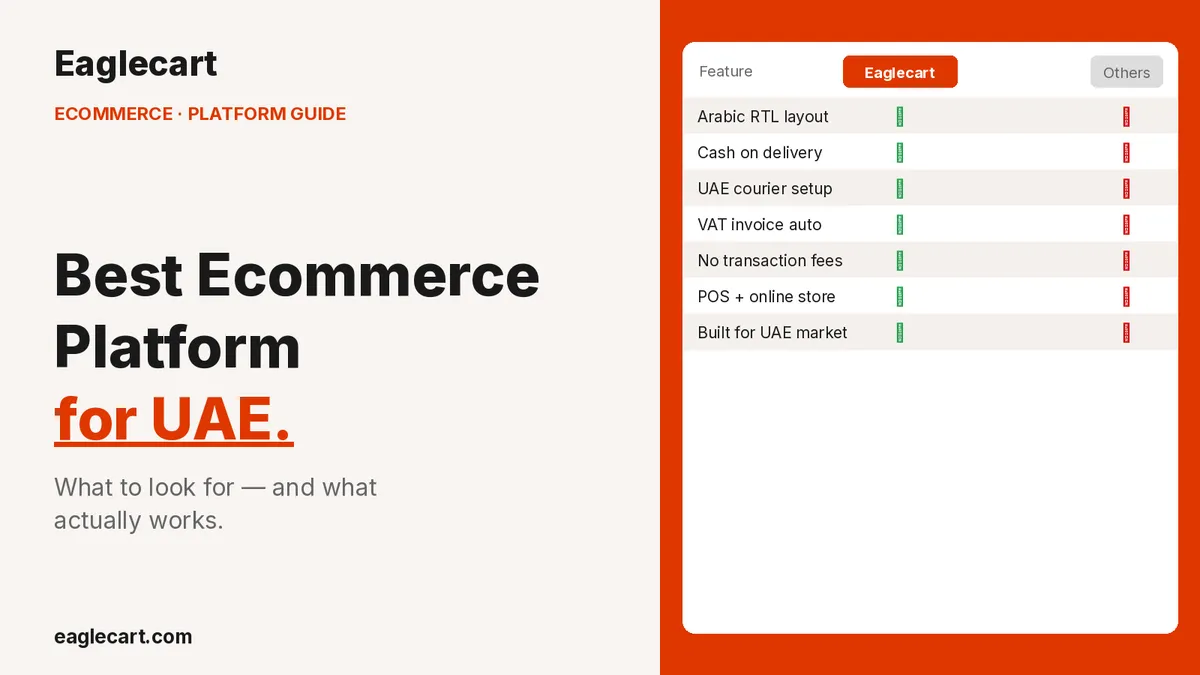
The best ecommerce platform for a small UAE business is the one that handles Arabic and English out of the box, supports cash on delivery, connects to UAE courier companies, generates VAT-compliant invoices automatically, and does not require a developer every time you need to change something. Most popular international platforms were not built with any of these requirements in mind — they were built for Western markets and adapted, imperfectly, for everywhere else.
I ran ecommerce in the UAE for years before building Eaglecart. I used other platforms. I know exactly where they fall short because I experienced it personally: Arabic text that rendered incorrectly, payment gateways that did not support dirham-denominated COD, courier integrations that simply did not exist for UAE logistics providers, and VAT invoice generation that required a third-party plugin. Every gap cost time and money.
A UAE ecommerce platform must support Arabic RTL layout, cash on delivery, UAE couriers, and VAT invoicing — not as add-ons, but built in from the start.
Cash on delivery is not optional in UAE ecommerce — platforms that do not support it natively will cost you a significant share of your orders.
Separate Arabic URL paths (not just text translation) are required for your Arabic content to rank in Google Arabic searches.
Eaglecart was built by someone who ran UAE ecommerce at scale — which is why it handles these requirements without workarounds.
What "Built for UAE" Actually Means
When a platform says it supports multiple languages, that usually means it can display translated text. What it rarely means is that it supports a fully RTL layout where every element — navigation, product listings, checkout flow, buttons, input fields — flips correctly for Arabic readers. This distinction matters. A product page with Arabic text sitting inside an LTR layout looks broken to an Arabic-speaking customer. They leave immediately.
Built for UAE also means the platform treats cash on delivery as a primary payment method, not an afterthought. In the UAE, a large portion of online shoppers — especially first-time buyers and buyers outside Dubai — prefer to pay on delivery. A platform that treats COD as an edge case, or requires a plugin to enable it, is already miscalibrated for your market.
It means native integration with UAE courier companies for automated shipping label generation, tracking number updates, and proof of delivery. It means VAT invoice generation that automatically applies the correct 5% rate, includes your TRN, and produces a document that meets FTA requirements — without a third-party plugin. These are not nice-to-haves. They are the daily operational requirements of running an online store in the UAE.
The Hidden Cost of Adapting a Non-UAE Platform
When I was scaling our ecommerce operation — processing over 1,700 orders a day across a 30,000 sq ft warehouse — I learned exactly what it costs to run a business on a platform not designed for your market. Every workaround takes time. Every plugin adds a monthly fee and a new point of failure. Every gap between what the platform does and what UAE operations require is a gap your team fills manually.
Consider the Arabic translation scenario. You pay for a translation plugin, configure it, and discover that the checkout flow — the most critical step in the purchase — still renders left-to-right because the plugin only handles content, not layout. Your Arabic-speaking customers see a broken checkout. You lose the sale. The plugin company tells you this is a known limitation. You spend a week trying to fix it with CSS overrides. This is not a theoretical problem — it happens regularly.
Or the VAT scenario. You set up your store, start selling, and discover that the invoices the platform generates do not include your TRN or a QR code. Your B2B customers need FTA-compliant tax invoices. You install an invoice plugin. The plugin does not sync correctly with your orders. Your accountant ends up manually creating invoices in a spreadsheet. Every sale requires a manual step that a UAE-built platform would have handled automatically from day one.
What to Actually Look For
When evaluating ecommerce platforms for a UAE small business, the checklist is specific. Arabic and English in one store — not a separate Arabic website, but one unified store with proper RTL Arabic paths that search engines can index separately. Cash on delivery built in, not via a plugin. Integration with at least one major UAE courier for automated shipping. VAT invoice generation that includes TRN and meets FTA format requirements. Bilingual product content — Arabic product names, descriptions, and category pages.
Beyond the UAE-specific requirements, a small business needs pricing that is not punishing at low volumes. Many international platforms charge per transaction on top of monthly fees. On thin UAE margins, per-transaction fees cut directly into profitability. A flat monthly fee with no transaction percentage is what a small business actually needs.
The platform also needs to be manageable by a business owner without technical support. If adding a product, updating a price, or running a promotion requires developer involvement, the operational overhead quickly becomes unsustainable. A small UAE business owner is managing a shop, customers, suppliers, and staff simultaneously — the platform has to be something they can manage themselves in the gaps between everything else.
How Eaglecart Approaches These Requirements
Eaglecart was designed specifically for UAE businesses because I built it after running UAE ecommerce at scale and experiencing precisely the gaps described above. The Arabic and English bilingual setup is not a translation layer sitting on top of an English-first platform — the RTL layout, separate Arabic URL paths for SEO, and bilingual product content are built into the core of how the store works.
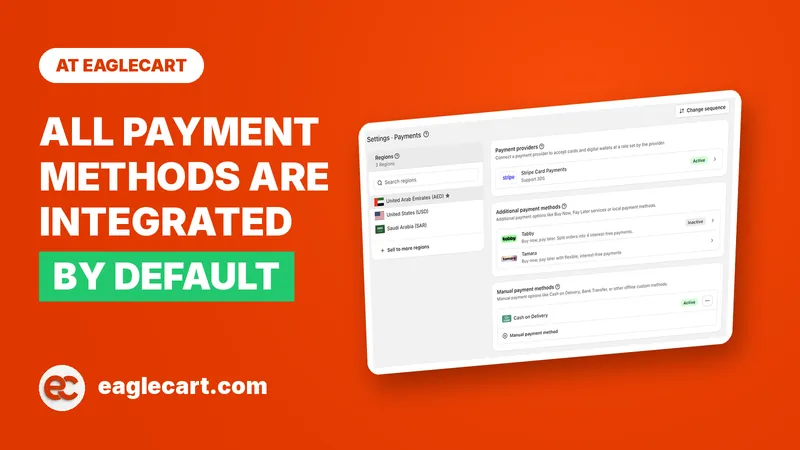
Cash on delivery is a native payment option alongside Stripe. UAE courier integration — including Jeebly — is built in, with shipping label generation and tracking handled from the order management panel. VAT invoices are generated automatically for every order, including TRN, the correct 5% rate, and the format required by UAE regulations.
The platform connects to the rest of your business operations. If you have a physical retail store, your POS shares the same inventory as your online store — selling the last unit in-store immediately removes it from your online listings. If you have a warehouse, the WMS connects to your store so order fulfilment flows without manual steps. A platform that cannot grow with you is a platform you will have to replace.
Pricing That Matches Small Business Reality
Eaglecart's online store starts at AED 99 per month with no per-transaction fees and no minimum contract period. For a small UAE business doing even modest online sales, the cost is recovered quickly against the time saved on manual invoicing, order tracking, and inventory management alone.
The modular structure means you pay for what you use. Start with the online store. Add POS when you open a physical location. Add the warehouse module when your operation requires it. Start affordably and scale without switching platforms as you grow.
Visit eaglecart.com to start your free trial. No credit card required to begin, and setup takes less than a day for a standard product catalogue.
Built for UAE. Ready from day one.
Arabic, VAT, COD, UAE couriers — all built in. No plugins, no workarounds. From AED 99/month with no transaction fees.
Start Free at eaglecart.comFrequently Asked Questions
What ecommerce platform is best for selling in Arabic and English in UAE?
You need a platform with native RTL Arabic support and separate Arabic URL paths — not just a translation plugin. Eaglecart is built bilingual from the core, meaning your Arabic store has proper layout, separate SEO-indexed URLs, and full bilingual product content without any add-ons.
Does a UAE ecommerce platform need to support cash on delivery?
Yes. A significant portion of UAE online shoppers — particularly outside central Dubai — prefer to pay on delivery. A platform without native COD support will lose a material share of your potential orders. Eaglecart supports cash on delivery as a built-in payment option alongside card payments via Stripe.
Do I need a developer to set up an ecommerce store in UAE?
Not with the right platform. Eaglecart is designed for business owners to set up and manage themselves — products, pricing, courier connections, payment methods, and VAT settings are all self-service through the admin panel. If you can manage a WhatsApp group, you can manage Eaglecart.
How important is UAE courier integration for an online store?
Without courier integration, every order requires manual entry into a shipping portal, manual tracking updates, and manual proof of delivery management. Eaglecart's integration with Jeebly and other UAE couriers automates label generation and tracking directly from the order management panel.
Does Eaglecart generate VAT-compliant invoices for online orders?
Yes. Every Eaglecart order automatically generates a VAT invoice that includes your TRN, the correct 5% VAT calculation, and the format required under UAE FTA guidelines. No separate plugin or manual invoicing step required.
What is the monthly cost for an ecommerce store on Eaglecart?
Eaglecart's online store starts at AED 99 per month with no per-transaction fees and no minimum contract period. Higher plans (AED 199, 399, 999) include additional modules such as POS, warehouse management, and workshop management. You pay for what your business actually uses.
Can I manage both an online store and a physical shop on one platform?
Yes. Eaglecart's online store and POS module share a single inventory pool. When a product sells in-store, the online store updates immediately. When an online order comes in, it flows through the same order management panel as in-store sales. One platform, one inventory, all channels.