How to Sell Online in UAE: What You Actually Need
How to Sell Online in UAE — What You Actually Need to Get Started
Selling online in the UAE is more accessible than most people think — and more complicated than most "start your business today" social media posts suggest. The gap between those two realities is where new sellers lose money, time, and energy.
I started selling online in the UAE in the marketplace era. No website, no warehouse, no team — just products, a price, and hope. Over the following years I scaled to 1,700 orders a day, a 30,000 sq ft warehouse, and 74 staff. What I know about starting and scaling in this market comes from having done it at every stage, not from reading about it.
You need a valid UAE trade license to sell online legally — a freelance permit works for some categories but not all.
Your platform must support Arabic, cash on delivery, and local courier integration to compete in the UAE market.
Starting with a proper online store — not just a marketplace listing — gives you customer data, pricing control, and a brand you own.
You can start for AED 99/month on Eaglecart and have a working UAE online store live within a day.
The Trade License Question
You need a UAE trade license to sell online legally. This applies whether you are selling physical products, digital products, or services. The specific license category depends on what you sell — a general trading license covers most physical goods, while specific categories like food, cosmetics, or electronics may need additional approvals.
Mainland Dubai Commercial License from the Department of Economic Development (DED) is the most common route. Free zone licenses — from Dubai Internet City, Sharjah Media City, and similar — are valid for ecommerce and often faster and cheaper to set up, but have specific rules about where you can operate physically. Check with a business setup advisor for your specific situation, as the rules change and vary by emirate.
A common misconception is that you can sell online without any license if you keep the volume low. You cannot. The FTA and licensing authorities audit online sellers. Operating without a license gets you fines and account closures on the platforms you sell through.
Choosing What to Sell — The UAE Market Has Specific Patterns
The UAE is a high-consumption market with strong demand for electronics, fashion, home goods, beauty products, and specialty food. It also has a significant expat population with specific home country preferences, which opens niche opportunities that do not exist in purely local markets.
What sells well online in the UAE is not always what sells well in Europe or the United States. Shipping times matter enormously here — customers in UAE have been trained by same-day and next-day delivery to expect fast fulfilment. If your product is coming from overseas with a two-week delivery window, you are competing against local sellers with next-day delivery. That is a hard gap to overcome with price alone.
Start with products you can source locally or stock in the UAE. The margin pressure from shipping costs on international stock eats into profitability faster than most new sellers expect.
Setting Up Your Online Store
Your store needs to do several things that generic international ecommerce platforms often do not handle well for the UAE market. It needs to support Arabic with proper right-to-left layout — not just text translation. It needs to accept cash on delivery. It needs to connect to local courier companies for same-day and next-day delivery. And it needs to generate UAE-compliant VAT invoices if you are registered for VAT.
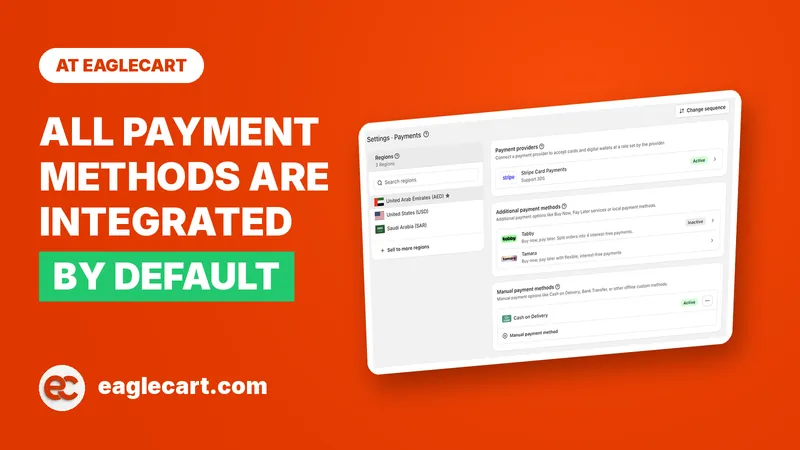
On Eaglecart, all of these are built in. You set up your store, add your products in both Arabic and English, connect Stripe for card payments and cash on delivery, and integrate with local couriers for delivery management. The whole stack is designed for the UAE market because it was built by someone who ran a UAE ecommerce business at scale — not adapted from a Western platform with local workarounds bolted on.
Payments: What UAE Customers Actually Use
Internationally, credit card checkout is the default. In the UAE, it is more nuanced. Debit and credit card payments work well, particularly among younger, urban customers. But cash on delivery is still widely preferred — especially for first purchases from unfamiliar stores, for customers outside the major urban centres, and for higher-value orders where buyers want to inspect before paying.
Refusing cash on delivery in the UAE is refusing a sale.
I learned this the hard way. We pushed toward card-only checkout to reduce the operational complexity of handling cash returns on delivery failures. We lost sales we could see directly in our analytics. We added cash on delivery back and the conversion improved immediately. Your store must offer both card payment and cash on delivery to capture the full UAE buyer market.
Delivery and Logistics
Delivery expectation in the UAE has been set high by the major platforms. Customers expect to choose a delivery time window, receive tracking updates, and have the option to reschedule. For a new seller, matching this expectation requires working with a local courier that offers these features — not just handing packages to a generic logistics company.
Eaglecart integrates with local UAE couriers so your orders flow directly from your store into the courier's system. You do not need to manually input delivery details. The customer gets an automated tracking notification. The courier collects cash on delivery on your behalf.
Manual order processing via WhatsApp works for ten orders a week. It breaks at ten orders an hour. Get the right system before you need it.
Inventory and Product Management
Even if you start small, track your inventory properly from day one. Overselling — confirming an order for a product you do not have in stock — is one of the fastest ways to destroy customer trust and generate negative reviews. In the UAE, customer feedback spreads quickly. One bad experience shared in a WhatsApp family group can reach fifty people overnight.
Eaglecart tracks inventory automatically with every sale. When a product goes to zero, it goes out of stock on your storefront without you having to remember to update it manually. This sounds basic, but it is exactly the kind of thing that breaks down when you are managing fifty products and handling customer service at the same time.
Start Focused, Grow Once You Have Proof
The mistake most new online sellers make is at one of two extremes. They either treat the store like a hobby and never invest in proper systems — or they spend heavily on branding, advertising, and inventory before they have validated what sells. Neither works.
Set up a proper store on a real platform. Start with a focused product range you know you can fulfil. Grow the catalog once you have proven the channel works. That is it.
Eaglecart plans start from AED 99 per month — full online store with bilingual support, inventory tracking, order management, VAT invoicing, payment integration, and courier connection. You do not need ten separate subscriptions to get this working.
Visit eaglecart.com and start your free trial today.
Start selling online in UAE the right way
Arabic + English store, cash on delivery, local couriers, VAT invoices — everything you need, built for UAE, from AED 99/month.
Start Free at eaglecart.comFrequently Asked Questions
Do I need a trade license to sell online in UAE?
Yes. A valid UAE trade license is required regardless of volume. Free zone ecommerce licenses are often faster to obtain; mainland DED licenses give you broader operational flexibility. Get this sorted before you take your first order.
Can I sell on my own website and on marketplaces at the same time in UAE?
Yes, and many UAE sellers do both. Your own store gives you the customer database, full control over pricing, and a business asset you own outright. Marketplace accounts can be suspended without warning — your own store cannot be taken from you.
What is the cheapest way to start selling online in UAE?
An all-in-one platform is cheaper than piecing together separate tools. Eaglecart starts from AED 99 per month — hosting, product management, payments, and order tracking included. Add products, connect a payment method, and you can take your first order within hours.
Do UAE online stores need to charge VAT?
If your taxable turnover exceeds AED 375,000 annually, you must register for VAT and charge 5% on applicable sales. Eaglecart handles VAT calculation and invoice generation automatically once your TRN is in your account settings.
How do I handle delivery for an online store in UAE?
Connect your store to a local UAE courier that handles pickup, delivery, tracking, and cash on delivery collection. Eaglecart integrates with local couriers so order details flow directly from your store to the courier — no manual data entry.
How long does it take to set up an online store in UAE?
With Eaglecart, most sellers are live within one to two days. Add your products, configure payments, connect a delivery method, set your domain. No developer required.