UAE E-Invoicing 2026: What Small Businesses Must Know
AE E-Invoicing 2026: What Every Small Business Needs to Know
If you run a business in the UAE and you are still issuing invoices on paper, in Excel, or through a basic template you downloaded years ago, the rules are changing — and they are changing faster than most small business owners realise.
The UAE is moving toward mandatory e-invoicing. For small businesses, this is not a distant corporate concern. You need to understand it and prepare for it now.
Key Takeaways
UAE mandatory e-invoicing is coming — the QR code requirement on simplified invoices is already law since January 2023.
Small businesses with a VAT registration must issue tax-compliant invoices — manual methods will not be enough.
A compliant UAE invoice must include your TRN number, VAT amount, and a QR code where required.
Moving to proper invoicing software now saves you from penalties later and makes VAT filing straightforward.
What E-Invoicing Actually Means for UAE Businesses
E-invoicing does not simply mean sending an invoice by email. It means issuing a structured digital invoice that meets the requirements set by the Federal Tax Authority — with the correct fields, correct VAT calculation, and in some cases a QR code that allows auditors to verify the transaction instantly.
The UAE VAT law has required proper tax invoices since VAT was introduced in January 2018. What is evolving now is the enforcement and the digital infrastructure behind it. The FTA is building toward a real-time invoice reporting system, similar to what Saudi Arabia has implemented with its ZATCA phase one and phase two rollout. The UAE is on a similar path.
For a registered business, every sale above AED 10,000 to another VAT-registered business requires a full tax invoice. Sales below that threshold require a simplified tax invoice. Both must contain specific data fields — and missing any of them makes the invoice non-compliant.
What a Compliant UAE VAT Invoice Must Include
This is the part most small business owners get wrong. They send something that looks like an invoice but is missing the legally required fields. When an audit comes, that becomes a problem.
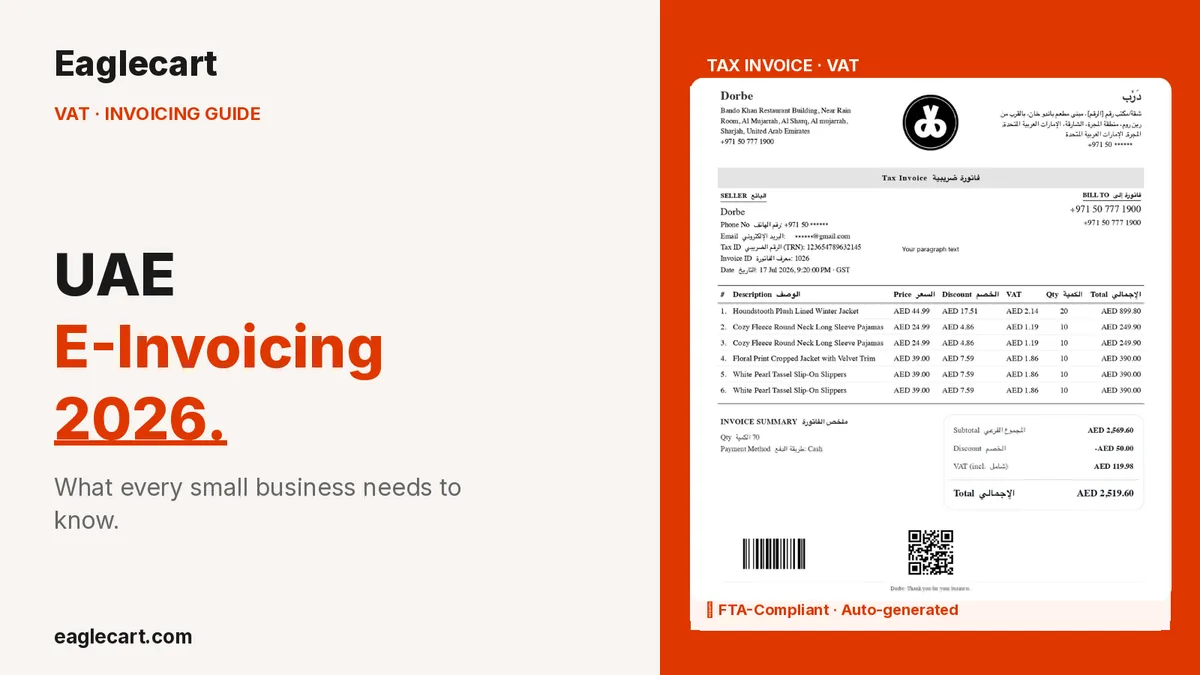
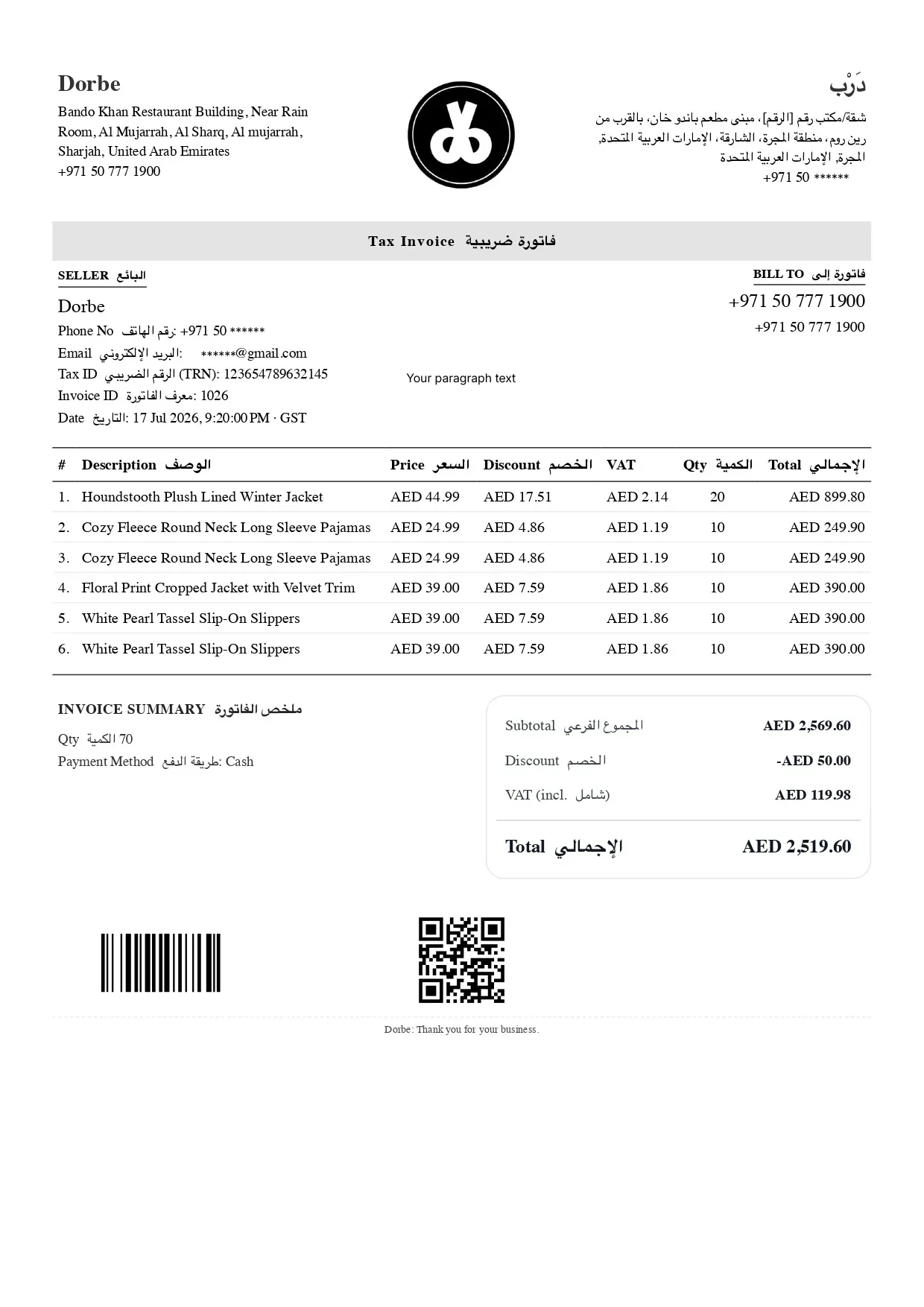
A proper UAE VAT invoice must carry the words "Tax Invoice" in both English and Arabic. It must show your Trade Name and address, your Tax Registration Number (TRN), the invoice date, a sequential invoice number, the buyer's details (for B2B transactions), a description of goods or services, the quantity, unit price, any discounts, the applicable VAT rate (5%), the VAT amount in AED, and the total amount payable including VAT.
For B2B invoices above AED 10,000, the buyer's TRN must also appear. For retail and consumer-facing invoices, a simplified version is acceptable — but it still needs your TRN and the VAT amount clearly shown.
Why Small Businesses Are Most at Risk
When I was running our ecommerce operation at 1,700 orders a day, I understood very quickly that every invoice was a legal document. One wrong field, one missing TRN, one incorrect VAT calculation and you could find yourself in a dispute with a customer, a supplier, or the FTA itself.
Small businesses rely on manual methods the longest. An Excel sheet works until it does not. A paper receipt book is fine until a VAT audit arrives and an inspector asks for structured records.
The penalty for non-compliance is not small. The FTA can issue fines for incorrect invoices, late filings, and record-keeping failures. The businesses that suffer most are the ones that grew fast without updating their back-office systems. They are generating revenue, but their invoicing is still in 2015. That gap is what regulators notice.
The QR Code Requirement and What It Signals
Since January 2023, simplified tax invoices in the UAE must carry a QR code that encodes key transaction data — seller name, TRN, invoice date, VAT amount, and gross amount. This is already law, not a future requirement. If you are issuing simplified invoices from a POS or directly to retail customers and they do not carry this QR code, you are already non-compliant.
The QR code requirement signals exactly where this is heading. The FTA wants invoice data to be machine-readable, instantly verifiable, and centrally trackable. Your invoicing system must be capable of generating this data automatically. A Word template or Excel sheet cannot do that.
How to Prepare Your Business for E-Invoicing Compliance
The practical answer is to move your invoicing onto a proper system before you are forced to — not after a fine arrives.
Make sure your business details are complete and accurate in whatever system you use: legal trade name, TRN, address, and contact. These must appear on every invoice. Your system needs to calculate VAT at 5% automatically and show the breakdown clearly. It should generate sequential invoice numbers that cannot be edited retroactively. And it must produce a QR code on simplified invoices.
At Eaglecart, the invoicing module handles all of this automatically. Every invoice carries your TRN, calculates VAT, generates a sequential number, and produces the correct fields for both full tax invoices and simplified ones. You do not need to remember the rules — the system follows them for you. Plans start from AED 99 per month, which is a fraction of what a single FTA penalty would cost.
VAT Filing Becomes Much Easier When Your Invoices Are Clean
Every quarter, UAE VAT-registered businesses must file a return with the FTA showing total sales, total purchases, output VAT collected, input VAT recoverable, and the net VAT payable. If your invoicing is manual and disorganised, pulling these numbers together is a nightmare.
I have seen business owners sitting with an accountant the night before the filing deadline, trying to piece together three months of transactions from WhatsApp screenshots and paper receipts. Do not let that be you.
Proper invoicing software does not just protect you from fines. It gives you real visibility into your business — which invoices are paid, which are outstanding, what your monthly revenue looks like, and what VAT you owe, at any point, in real time.
E-Invoicing Compliance Is Not Optional — Get the Right System
The businesses that will struggle are the ones that treat invoicing as an afterthought. The ones that will not have a problem are the ones that get their back office clean now, before enforcement tightens further.
If you want to see how Eaglecart handles UAE VAT invoicing — including TRN fields, VAT calculation, QR codes, and bilingual support — visit eaglecart.com and start a free trial. No complicated setup. No accountant needed on day one.
Ready to issue compliant UAE VAT invoices?
Eaglecart generates TRN-compliant, QR-coded, bilingual tax invoices automatically — from AED 99/month.
Start Free at eaglecart.comFrequently Asked Questions
Does every UAE business need to issue a VAT invoice?
Only VAT-registered businesses. If your annual taxable turnover exceeds AED 375,000, you must register for VAT and issue compliant tax invoices for every sale. Below that threshold, voluntary registration is available from AED 187,500.
What happens if I issue a non-compliant VAT invoice in the UAE?
The FTA can fine you. Penalties apply for missing required fields, incorrect VAT amounts, and record-keeping failures — fines start at AED 5,000 per incorrect invoice in serious cases. Getting this right upfront costs far less.
Is a PDF invoice compliant with UAE e-invoicing rules?
It can be, if it contains every required field — TRN, VAT amount, sequential number, QR code for simplified invoices, and bilingual labelling. A PDF generated by a proper invoicing system is acceptable. A manually designed PDF template is risky because it is easy to miss a field.
What is the QR code requirement on UAE invoices?
Since January 2023, simplified tax invoices must carry a QR code encoding seller name, TRN, date, VAT amount, and gross total. This is already law. Eaglecart generates this QR code automatically on every applicable invoice.
When will the UAE introduce full e-invoicing like Saudi Arabia?
The UAE is building toward mandatory real-time e-invoicing following the Saudi ZATCA model. Treat it as a near-term reality. Starting with compliant software now means you will not need to scramble when the mandate becomes enforceable.
Can Eaglecart handle both B2B and B2C VAT invoices?
Yes. Eaglecart supports full tax invoices for B2B transactions — including buyer TRN field and line-by-line VAT breakdown — and simplified invoices for retail sales. Both formats are bilingual in Arabic and English and include QR codes where required.